Maps
Overview
A map is represented by a Map object, that represents a two-dimensional slice (or many slices) of radiometric data.
We can download a pre-defined maria maps with
import maria

m = maria.map.get("maps/M1.h5")

print(m)
m.plot(slices="all")
(Source code, png, hires.png, pdf)
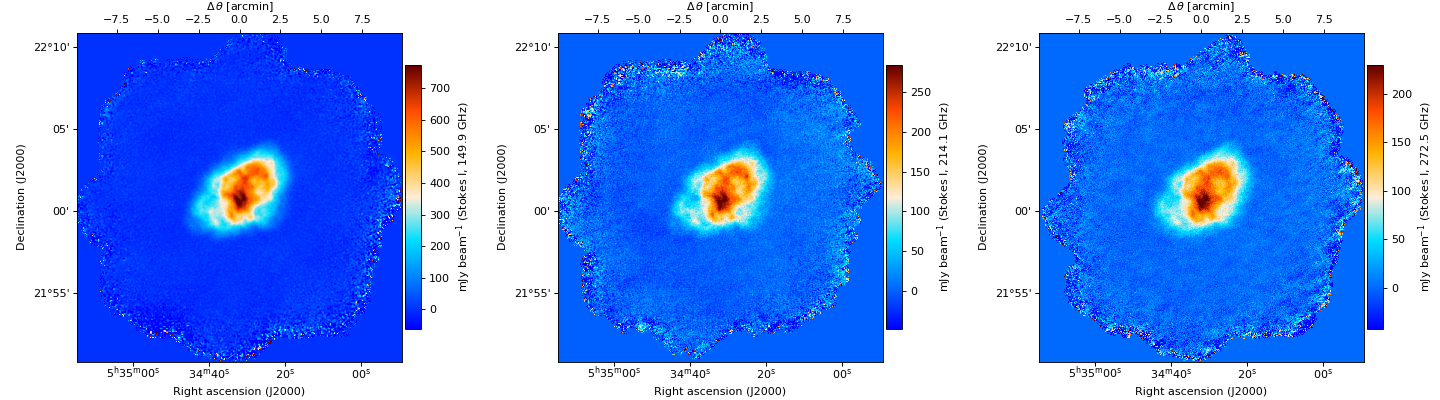
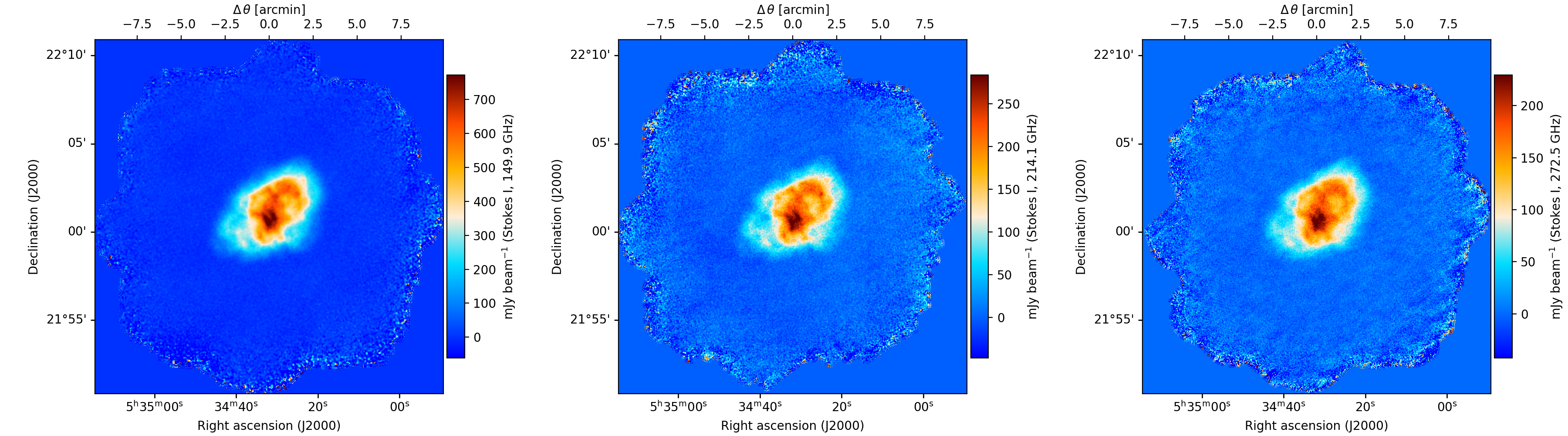
Hint
To see all available pre-defined maps, run print(maria.all_maps). For documentation on customizing these inputs, see the Instruments, Sites, and Plans sections.
Loading from a file
If you have a local map file (either as an .h5 file or a .fits file), you can load it into maria as
m = maria.map.load("my_fits_map.fits")
m = maria.map.load("my_hdf_map.h5")
When constructing the map, maria will try to infer map metadata from the file.
Warning
maria can handle most FITS (Flexible Image Transport System) files, but the “flexible” part means that there are too many possible conventions for maria to be able to parse reliably. If maria cannot parse a FITS file header, you can specify the map metadata manually as demonstrated below.
Passing additional arguments to maria.map.load will override any metadata. For example, running
m = maria.map.load("my_fits_map.fits", width=1, units="uK_RJ", nu=150e9)
will scale the size of the map to be one degree wide, and interpret the map values as being in units of microKelvin Rayleigh-Jeans at 150GHz.
Warning
When overriding metadata, any passed dimensions must match the shape of the map; passing a single frequency to a three-dimensional map with dimensions (nu, y, x) = (10, 256, 256) will throw an error.
Units
A Map in maria can be represented in several different units.
Quantity |
Units |
|---|---|
Rayleigh-Jeans temperature |
|
Brightness temperature |
|
Spectral flux density per unit area |
|
Compton y |
|
maria will try to parse a given units string (e.g. aliases like Jy/pix or Jy pix**-1 for Jy/pixel) as well as any valid SI prefix (like mK_RJ).
A map can be converted from one set of units to another as
map_in_K_RJ = map_in_some_other_units.to("K_RJ")
Note that while a map can have units of e.g. Jy/pixel without any frequency information, it cannot be converted to another quantity without specifying a frequency.
We can add a frequency dimension to a map as
map_with_frequency_dim = map_without_frequency_dim.unsqueeze("nu", 150e9)
Manual construction
We can manually create a map from a two-dimensional array of data as
from maria.map import ProjectionMap

m = ProjectionMap(data=data, # an array with shape (n_y, n_x)
                  weight=weight, # optional, must be the same shape as 'data'
                  units=units, # required
                  center=(ra, dec), # or (glon, glat)
                  frame="ra/dec", # or "galactic"
                  resolution=1e-3, # spacing between pixels, in degrees
)
To create a map for data with more dimensions, we
from maria.map import ProjectionMap

m = ProjectionMap(data=data, # an array with shape e.g. (stokes, freq, y, x) = (4, 3, 256, 256)
                  weight=weight, # optional, must be the same shape as 'data'
                  units=units, # required
                  center=(ra, dec), # or (glon, glat)
                  frame="ra/dec", # or "galactic"
                  resolution=1e-3, # spacing between pixels, in degrees
                  stokes="IQUV",
                  nu=[nu1, nu2, nu3],
)
Slices
Dimension |
Description |
Default units |
Valid values |
|---|---|---|---|
|
Stokes parameter |
None |
A combination of |
|
Frequency |
|
Any positive number |
|
Redshift |
None |
Any positive number |
|
Radial velocity |
|
Any number |
|
Redshift |
|
Any number |
HEALPix maps
Defining a HEALPix map is much the same as with a two-dimensional map:
from maria.map import HEALPixMap

m = HEALPixMap(data=data, # an array with shape e.g. (stokes, freq, pixels) = (4, 3, 786432)
               weight=weight, # optional, must be the same shape as 'data'
               units=units, # required
               frame="ra/dec", # or "galactic"
               resolution=1e-3, # spacing between pixels, in degrees
               stokes="IQUV",
               nu=[nu1, nu2, nu3],
)